Online Tutorial Radio Interferometry
Sylvia Adscheid, Dr. Beth Jones, Dr. Stefanie Mühle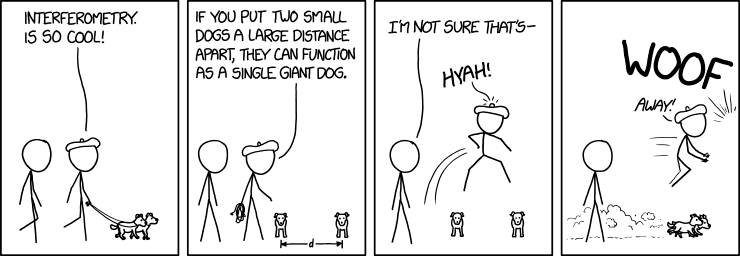
(https://xkcd.com/1922/)
Join the gold rush in the "Golden Age of Astronomy"!
The Atacama Large Millimeter/submillimeter Array (ALMA), the world-leading interferometer in the mm-/submm-wavelength range, produces hundreds of gigabytes of astronomical data of unprecedented sensitivity and resolution during each night of regular operations, turning the public ALMA archive into a goldmine for those knowledgeable in the art and craft of radio interferometry.
This online tutorial on radio interferometry offers hands-on training in the data reduction and analysis of radio interferometric data at a level suitable for Master students, PhD students and more senior astronomers. Familiarity with the basic concepts of radio interferometry is recommended.
After a brief review of the basic concepts of radio interferometry, you will be guided through the various steps necessary to create fully calibrated data cubes from interferometric raw data using ALMA raw data as an example. In the second part of the course, you will learn how to construct data cubes and maps from the calibrated data and how to analyze the interferometric data.
If you install the versatile Common Astronomy Software Applications (CASA) package on your computer, you can practice the individual steps on the demo data set while watching the tutorials and directly put your new knowledge to a test with a second data set.

How to participate
This radio interferometric data reduction tutorial is offered as a self-teaching course.
Master students in Bonn and Cologne:
If you are a Master student at the university of Bonn or Cologne, you can register for this self-teaching course. Please note that this is an elective course on practical research skills. There are no credit points attached to this course.
As part of the ALMA user support, the German ARC node offers a limited number of guest accounts on one of their powerful compute servers for the duration of the course. A fixed-time guest account can be requested via the organizers.
Other participants:
PhD students, postdocs, more senior astronomers and scientists of related fields are welcome to contact the organizers regarding access to the material for their own professional studies.
Logistics:
Time & date: |
self-study course, by individual arrangement |
Contact: |
Dr. Stefanie Mühle, muehle at astro.uni-bonn.de |