Effelsberg contribution to the B3/VLA survey
Homogeneous databases over a wide frequency range for a large sample of
radio sources with intermediate or low flux densities are an important
ingredient to modern astrophysics. We have therefore embarked on a project
to obtain flux densities for the B3-VLA sample over
a frequency range as wide as possible. The aim is to study the spectral
properties of a complete sample of radio sources. The B3-VLA sample is
composed of sources that are roughly equally distributed in 5 flux density
intervals, and that is 50 times fainter than the 3C survey. The
sample contains 1049 radio sources. The spectral database of the whole
sample comprises flux densities at 151 MHz, 327 MHz, 408 MHz, 1.4 GHz, 4.85
GHz, and 10.6 GHz.
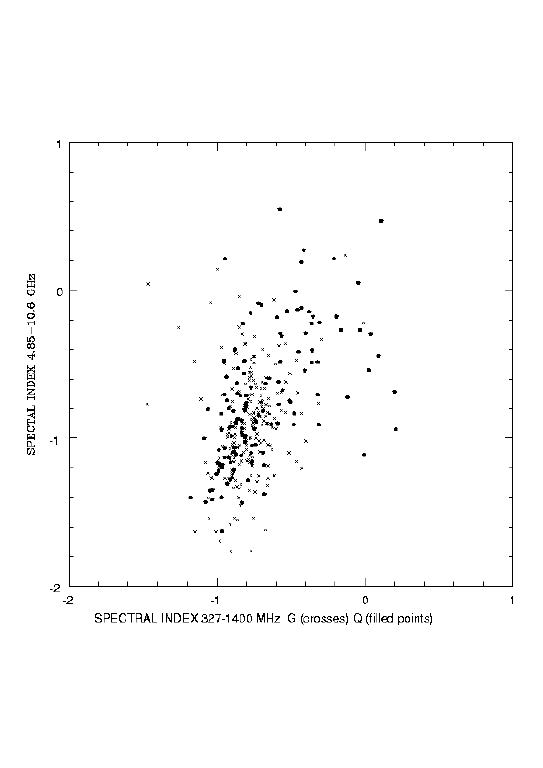
In the above figiure we show a radio colour-colour diagram illustrating the
differ-
ent population areas of radio galaxies and quasars. The high-frequency
spectral index exhibits a larger spread than the low-frequency one.
This is to be expected
if spectral steepening due to
synchrotron and inverse Compton energy losses is important: it changes
the high-frequency spectral index first, before the sources have aged
sufficiently such as to affect the low-frequency one as well. The ex-
pected evolutionary track in this diagramme would be roughly speaking that
re-
flected in the overall distribution of, in particular, radio
galaxies: if these sources commence their lives with flat
(injection) spectra, they should gradually move downward at a faster rate
than leftward. Also evident in the figure is that radio galaxies (crosses)
have on average steeper high-frequency spectra than quasars; in particular,
they dominate the lowest part of the diagramme.
A thorough statistical analysis of the B3/VLA source survey is in progress.
In particular, we are evaluating their polarization properties, along with
some 200 rotation measures that will reesult from this study..
|