Radio Interferometry SS 2026 (astro8404)
Prof. Dr. Frank Bertoldi, Prof. Dr. Arshia Jacob, Dr. Stefanie Mühle, Dr. Yiqing SongSylvia Adscheid, Lynn Hansen, Kamalpreet Kaur,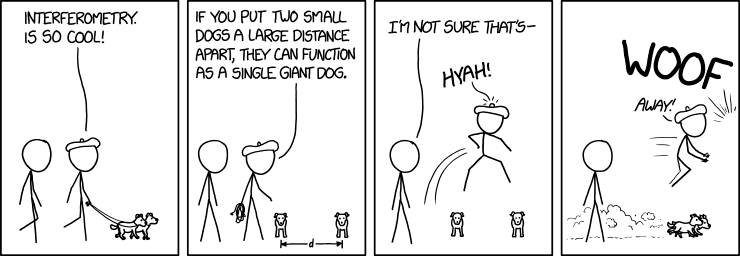
(https://xkcd.com/1922/)
Join the gold rush in the "Golden Age of Astronomy"!
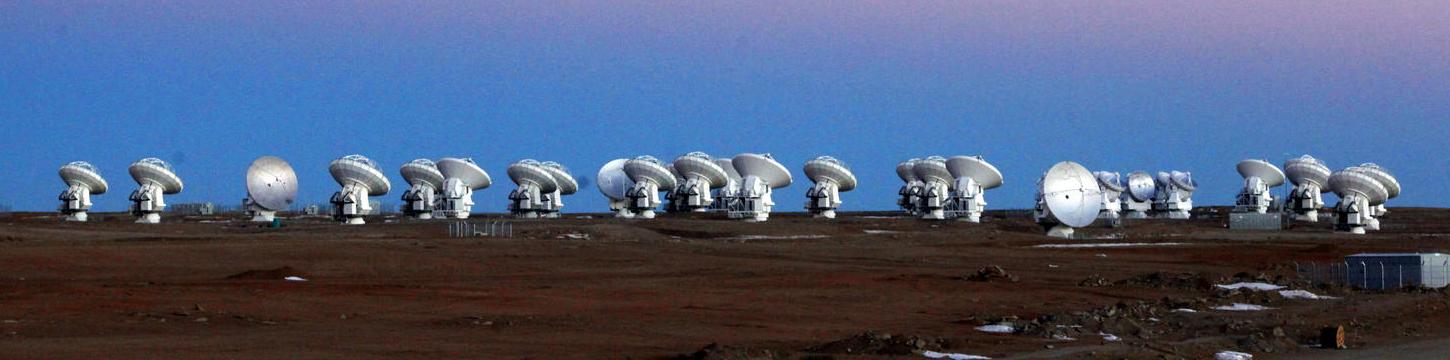
The Atacama Large Millimeter/submillimeter Array (ALMA), the world-leading interferometer in the mm-/submm-wavelength range, produces hundreds of gigabytes of astronomical data of unprecedented sensitivity and resolution during each night of regular operations, turning the public ALMA archive into a goldmine for those knowledgeable in the art and craft of radio interferometry.
The Master-level course "Radio Interferometry: Methods and Science" offers hands-on training in the data reduction and analysis of radio interferometric data for Master students, PhD students and more senior astronomers.
After a brief review of the basic concepts of radio interferometry, the participants are guided through the various steps necessary to create fully calibrated data cubes from interferometric raw data using ALMA raw data as an example. In the second part of the course, the participants learn how to construct data cubes and maps from the calibrated data and how to analyze their interferometric data.
Using the versatile Common Astronomy Software Applications (CASA) package, the participants can practice the individual steps on the demo data set already during class and/or practice their new knowledge with a second data set after class.
How to participate
This course is open to Master students, PhD students, postdocs, more senior astronomers and scientists of related fields.
Please bring a laptop, if available!
Students in Bonn and Cologne:
If you are a Master student at the university of Bonn or Cologne, you can take this course for credit, obtaining 4 CP.
Following the hands-on approach of the course, the coursework relevant for the final grade consists of assignments related to the data reduction and analysis of a small interferometric dataset, followed by a presentation (Referat, 15 min length) and a short paper summarizing the data reduction and the analysis (5-12 A4 pages).
For equal opportunity regarding computing ressources, the German ARC node offers access to one of their powerful compute servers to all students who take this course for credit. Access will be provided via a guacamole browser interface. Account request forms and details how to apply are available on eCampus. In order to get access to the compute server, all "for credit" students are requested to return the filled form "For credit" students are expected to attend all the lectures/tutorials and need to register for the exam on BASIS before the deadline.
Other participants:
As in previous years, Master students outside of the Bonn/Cologne region, PhD students, postdocs, more senior astronomers and scientists of related fields are very welcome to join the course via zoom. If you would like to participate, please contact us at "muehle at astro.uni-bonn.de". If you would like to follow along in the hands-on data reduction sessions, please install CASA on your home server and download the data sets from the material's page. The data sets and detailed installation instructions will be posted on the material's page in April.
Logistics:
Time & date: |
Thursdays, 16 April 2026 - 23 July 2026, 09:30-12:00, incl. break |
Location: |
AIfA lecture hall and CIP pool |
Organization: |
Prof. Frank Bertoldi, bertoldi at astro.uni-bonn.de |
Contact for remote participants: |
Dr. Stefanie Mühle, muehle at astro.uni-bonn.de |